How to make ASMR audio with AI
(and make money with it)
I'll be honest, you don't need a 3Dio mic or a treated room to make ASMR audio in 2026, because I've been generating whispered voice tracks from my laptop and most listeners can't tell them apart from a real soft spoken narrator. The models I've used can whisper and pause and breathe a bit, and they hold a slow sleepy pace. But here's the honest bit I've learned the hard way: AI can do the voice and it can't do the textures. Tapping on wood, brushing a mic, crinkling paper, none of that fakes well in my experience. So here's what I've found AI is good at, what still needs a real mic, and how I'd combine the two.
I've spent this year messing about with AI voices, and I already wrote about how I made £700 with voice cloning on ElevenLabs in 2026, so this isn't theory I've nicked from somewhere else. Below is the workflow I'd actually use: write a slow script, generate the voice in short chunks, layer real textures underneath, and master it for headphones.
What I've found AI is actually good at
I'll start with what surprised me most, because whispered speech is where these models really shine for me. A good voice holds a soft breathy whisper without sliding into a stage whisper or going robotic, and that's exactly what I've wanted for sleep tracks. Soft spoken narration is just as strong, that calm bedtime story delivery that doesn't jar you awake.
Pacing is the bit I didn't appreciate until I'd made a few tracks, and now I'd call it the quiet superpower. I slow the voice down and stretch the pauses between lines, and I drop breaths in where I'd take them myself. If a line feels rushed then I just regenerate it with more space around it. When I've recorded myself in the past, fixing pacing meant recording it all again, which drove me mad.
The other thing I've loved is casting multiple voices without any faff. I wanted a short series with a narrator plus a softer second character, and I cast both in an afternoon from stock voices, with no scheduling and no retakes. ElevenLabs has 11,000+ voices in the library, so I've never struggled to find a soft one I liked. And consistency comes free, which matters more than I expected: the model never gets a sore throat, so it sounds the same in every episode I make.
What AI still can't fake
Now the other side, and I'll be blunt because I wasted time here. AI voices can't fake physical trigger sounds, in my experience. I mean tapping on wood or glass, crinkling paper, brushing bristles across a mic grille, and those soft close mic clicks made right against a real diaphragm. These are textures and not speech, and voice models are trained on speech.
You'll hear the difference straight away, I did. Generated tapping sounds like a drum sample to me, while real tapping carries tiny variations in angle and pressure that I've never heard a model reproduce. And ASMR listeners are the most attentive audience I've come across, because people who fall asleep to this nightly will notice in seconds.
So the rule I've settled on is simple. If the sound comes from vocal cords then I'd let AI have a go, and if it comes from an object or a surface or contact with a mic then I'll record the real thing. That doesn't kill the AI workflow, it just splits the job. I record the textures and I generate the voice.
Three routes
Route A: text to voice. This is what I'd do if I wanted something out tonight. I pick a soft stock voice and paste my script in and generate, and I've gone from idea to finished voice track in minutes this way. It's genuinely good for whispered sleep audio and guided relaxation where my own voice doesn't matter. The tradeoff is that anyone can use the same stock voices, so my edge has to be the script and the sound design.
Route B: clone your own whisper. For this one I recorded around 30 minutes of clean audio of myself speaking softly, and I'd treat that as the minimum. I sat in a quiet room with no background noise and kept a steady distance from the mic, then trained a clone of my own voice. After that I could whisper with it late at night without waking anyone, and I've kept one recognisable voice across everything. The 30 minutes of clean recording is the real cost here, because rushed source audio gives you a clone that sounds wrong at whisper volume, where every artefact shows.
Route C: hybrid (recommended). This is the route I'd recommend if you're serious about ASMR as a channel or a product. I record the textures myself, so tapping and brushing and page turns and room tone, and I generate the voice, then I layer them together. The voice carries my script and the real textures carry the tingles. It needs a mic, which I've covered in the gear bit below, but it's far less time than recording everything live.
Step by step
- Write the script in short lines. I've learned ASMR scripts are closer to poetry than prose, so I write one idea per line with loads of white space and I write the pauses in. I read mine aloud slowly first, because if I stumble then the generated voice sounds awkward in the same spot.
- Choose a soft voice. I pick a whisper friendly stock voice or my clone, then I generate a test paragraph and listen on headphones before I'll commit to a full script. I've skipped this before and regretted it.
- Slow the pacing. I drop the speed and widen the gaps between lines, because sleep audio runs noticeably slower than conversation. If the tool has stability settings then I'd favour stability for whispers, since I've found fewer surprises is what you want.
- Generate in short chunks. I generate a paragraph or two at a time and never the whole script at once. Short chunks let me bin bad takes cheaply and fix mispronunciations, and they keep my pacing consistent. Then I stitch the keepers together in Audacity, which is free and does the job for me.
- Layer an ambient bed. I put something soft under the voice, like rain or brown noise or quiet room tone. I keep it low so the voice stays in front. This single step is what separates AI voiceover from ASMR audio in my tracks.
- Master for headphones. I use light compression to even out the whisper and a gentle lift in the highs for clarity, then a loudness pass so my quietest lines stay audible. I export at the best quality the platform accepts, then I listen to the whole thing on earbuds in bed. That's my QA, and I've caught loads that way.
Gear reality check
Forums will tell you to buy a binaural rig and acoustic panels and a pricey mic before you upload anything, and I'd say ignore all that. I've made perfectly listenable stuff without any of it. Here's what I've actually needed for each route.
Voice-only (Routes A and B): I've just used a laptop and headphones. The voice is generated so my recording gear barely matters, which still feels like cheating. A phone mic was fine for my first Route B training recording because the room was quiet, and I've recorded in a wardrobe full of clothes and been shocked how clean it sounded.
Hybrid (Route C): I've used a USB mic and that's been plenty. A Blue Yeti or similar with a pop filter does tapping and brushing and room tone nicely. I record close and quiet and I record loads of variations. I'd only buy the fancy binaural setup later, after the channel has earned it.
How I'd actually make money with it
I see four routes here, roughly in the order I'd expect them to pay, though I've not tried them all equally. None is fast at the start, and I'd be wary of anyone who says otherwise. What compounds is the catalogue, so that's the bit I'd focus on.
YouTube plus Patreon is the classic stack I'd start with. I'd use YouTube for discovery and ad revenue, and Patreon for early access and exclusive tracks and custom requests. I've noticed sleep content earns long listening sessions, which seems to help with discovery.
Sleep and meditation apps are the second route I'd look at, since they license or commission relaxation audio. I'd pitch finished tracks and not ideas, because a small portfolio of polished sleep audios opens doors a pitch deck never will. It's on my list.
Whisper-narrated audiobooks feel like an under-served niche to me: short fiction and poetry and public domain classics in a soft voice. Services like FastAudiobook turn a full book into whisper-narrated audio, and I'd price per finished hour like any other narrator.
Commissioned audio rounds it out: custom sleep tracks and name inclusion relaxations and brand work for wellness companies. I'd start with a simple rate card per finished minute and raise it as my backlog grows.
What it realistically pays. I've had to learn to think in finished minutes and not hours. A sleep track is a product and I'd price it like one, because most people starting out undercharge badly. They price the generation time, which is minutes, instead of the result, which is a listener sleeping. I'd build a rate card with three tiers, a single track and a small pack and a monthly custom slot, and let the middle tier do the work.
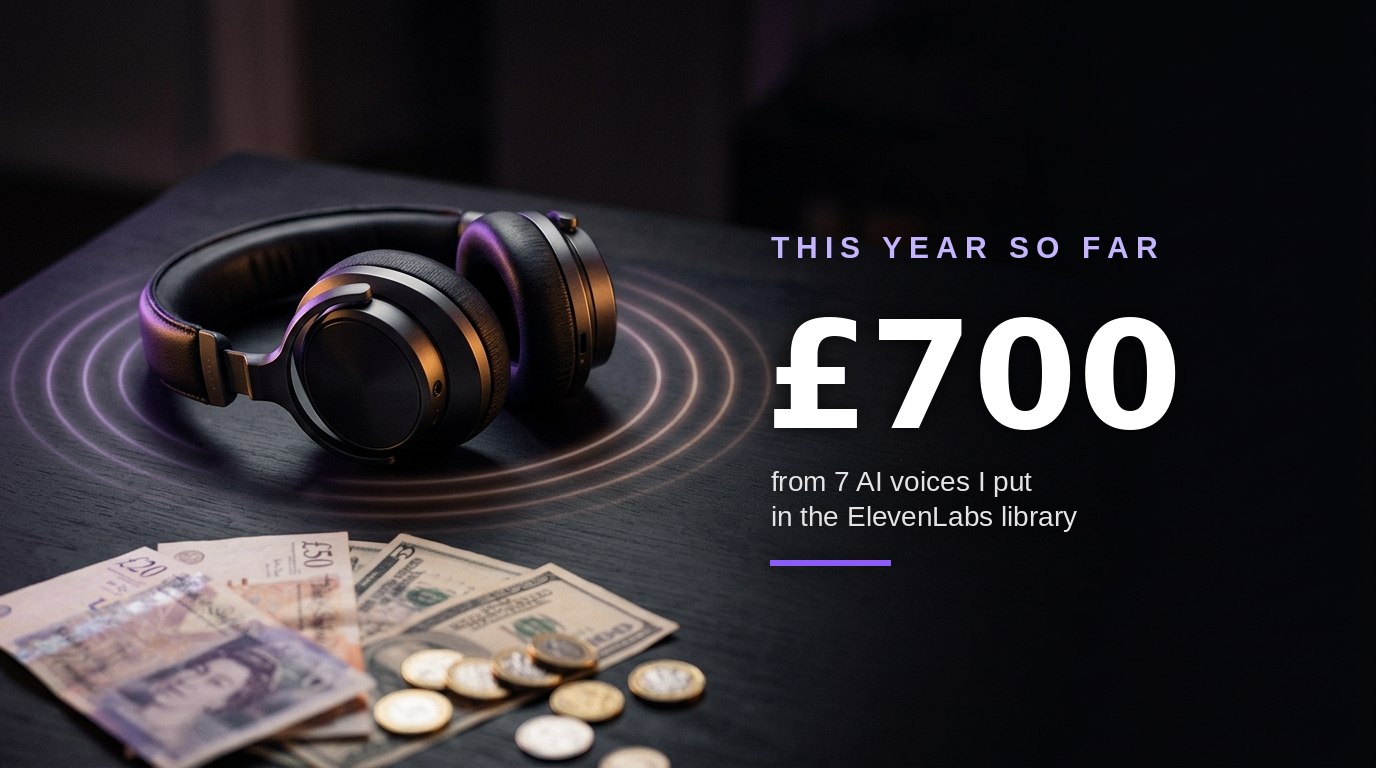
The honest maths: a small channel with a modest regular audience won't replace a job, and I'd rather tell you that straight. A catalogue of tracks that each sell occasionally, across a few platforms, will out-earn one lucky track that sells once. So I'd build for the catalogue. For context, I've made £700 from 7 voices I published to the ElevenLabs voice library in 2026, separate from anything I've tested with ASMR.
The rules I'd stick to
- Only clone voices you own or hold explicit written consent for. I'd never clone a celebrity or a public figure or anyone else's voice without permission. No impersonation, ever, and I don't bend on this.
- Keep mainstream platforms clean: I publish no NSFW content on YouTube, Patreon, or audiobook stores. Violations end accounts and appeals rarely succeed, so I don't risk it.
- Disclose AI where the platform requires it. YouTube requires disclosure of realistic synthetic content and audiobook platforms have their own AI narration labels, so I check the current policy before I publish. I'd label honestly regardless, because I've found listeners object far more to being misled than to AI voices.
- Respect script copyright: I write my own material or I license properly or I stick to public domain texts. It's not worth the headache otherwise.
FAQ
Can AI whisper convincingly enough for ASMR?
Yes, whispered speech and soft-spoken narration are what current voice models do best. Where they fall short is physical trigger sounds like tapping and brushing, which still need a real object and a real mic.
How much audio do I need to clone my own voice?
Around 30 minutes of clean, quiet recording. Quality matters more than quantity: consistent distance, no background noise, and soft delivery if you plan to whisper with the clone.
Do I need an expensive microphone?
Not to start. Voice-only tracks need nothing but a laptop and headphones, and a phone mic is fine for a first cloning session. Buy a USB mic only if you go hybrid and record your own textures.
Can I sell ASMR audio made with AI voices?
Yes, on platforms that allow synthetic voices: YouTube, Patreon, audiobook stores, and direct commissions all work. Always check the platform's current AI policy and disclose the AI voice where required.
Do I have to tell listeners the voice is AI?
Where the platform requires disclosure, yes, and it's good practice everywhere else. Label it once in the description and move on; most listeners care about the experience, not the tool.
More experiments like this on the posts page.